Tanveer Ahmed from Sydney wrote in today's Age suggesting that changes in medical education have not kept pace with other changes in the wider community, and that it is "one of the last bastions of the Old World left in our economy and requires a genuine shake-up... It is the East Germany of our society, waiting for its wall to fall."
Dr Ahmed (I don't know whether to refer to Tanveer as he or she) challenges the role of "systems, through colleges and apprentice-style training, that have effectively been unchanged for decades."
Let me tell you, Dr Ahmed, decades are not a long time. Our political system has not changed for over a century - is it time for a "radical shake-up"? Human anatomy has not been re-defined for at least several hundred years. Is it time to revamp the textbooks? Should we ditch the apprenticeship model that trains your plumber, electrician, painter or mechanic because it is not keeping pace with modern society?
There are a number of reasons that medical education and health systems have not been torn asunder and rebuilt every few years (despite what the ACCC may want).
Firstly, it is because small, incremental changes are happening all the time. This is how change is managed. Minor changes and improvements are introduced. They are assessed. If they work out they are kept, and if they don't they are reversed (let us hope the dilution of anatomy teaching will be reversed). We are not fighter pilots. We are doctors. The training produces flexible doctors who can make use of new technology, new information, new health system structures, and adapt to suit community requirements as they arise. If you knew that you needed fifteen left-handed dynamic hip-screw inserters in five years time you could train for that, but in five years time the DHS might be obsolete. And so will be your specialist DHS inserters.
Secondly, you may recall the Latin phrase "Primum non nocere" (First do no harm). Tearing down the public health system and medical education in one fell swoop would cause a lot of harm, long before it did any good, especially when no adequate replacement is conceived or planned for.
Thirdly, my favourite saying: "If it ain't broke, don't fix it". As you say, the current arrangement of "cheap labour in underfunded public hospitals... suits many people in authority, both within the profession and in government". Well, let me tell you, it also suits the common citizen holding their Medicare card, who gets first-world health-care for 1% of their gross taxable income each year. As doctors we may grumble and bitch about our lack of pay, long working hours, lack of recognition, long training periods, and no social life, but aren't you the least bit proud that you are providing the majority of your patients with health care that is the envy of many countries around the world?
If anything, the most frustrating part about being a doctor in Australia is that given state and federal funding constraints we can only provide some of the services to some of the people some of the time, but of what we do deliver it is still top quality care. Yes, my pay after 16 years of training is paltry compared to my younger cousin who reprograms the ATM system for a major bank, or my recently-graduated friend who advises semi-private health insurance companies how to waste the wads of cash they make every second. But I have the satisfaction of a patient coming up to me and saying "Thankyou for improving or saving my life" every now and again, and that makes me proud of what I do, despite the fact that the public health system uses and abuses me.
My concern is that if Tanveer's opinion translates to a general perception that doctors are over-trained, then we are looking at the inevitable extinction of the traditional doctor. No longer will we have a health professional who is expected to deal with anything and everything that could possibly come through the door, and to have a good grasp of all the other facets of health care and medicine that affect their patients - we will have a workflow-oriented, productivity-driven, multidisciplinary team-based system with cannulation technicians, specialist nurse practitioners, phlebotomists, reporting radiographers, analytic biochemistry technicians, and diagnostic hygiene specialists who will hold a committee meeting every half hour to discuss why the patient in Cubicle 21 is deviating from the ingrown toenail clinical pathway. There will not be a doctor to be seen because they will be unnecessary. Is this what the Productivity Commission wants?
I might as well retire today. Perhaps we should not be reforming our health-care system or medical training, just our expectations of what it should deliver.
Wednesday, September 20, 2006


Thursday, September 14, 2006
Doctor Death - or Doctors' Deaths
It was only a matter of time before the papers wrote it up (Young doctors succumb to killing pressures on the ward, The Age 13/9/06) but it concerns me as always that the focus is on working hours (Young doctors' rest-deprived life, The Age 14/9/06). I have written about this before (Doctors get stressed too).
Yes, as hospital doctors we work long hours. Yes, most hospitals have little incentive to reduce working hours (despite the AMA's Safe Hours campaign - potentially flawed as it may be). But don't confuse long working hours with causing doctor suicides. It is a single factor among many others, including long-term responsibilities for patient care; work conflicts with other medical teams and other staff; mixed loyalties to patients, bosses, friends, colleagues, and families.
Personally, I believe that many of these stressors are offset by the rewards: that satisfying feeling of successfully fixing a patient's problem, and talking to a grateful patient and family; being appropriately remunerated for one's services; having a sense of standing within the community; spending fruitful and rewarding time with one's friends and family. I work long hours. I experience stress at work. But I experience the rewards and I do not mind. Some of my colleagues, however, are denied those rewards on a regular basis.
Stressors will not go away. To take them away requires a massive restructuring of our health system which is economically impossible, and despite a lot of empty rhetoric from state and federal governments, is not in their interests. We may whine on about reducing working hours (at the cost of prolonging postgraduate medical training), employing more junior hospital doctors (Where will they come from? Where will they go afterwards? Where is the career path for "hospitalists"?), buying more fancy equipment (equipment is cheap, people are expensive), but at the end of the day, it is all political pseudospeak.
You want to know what the real factor in doctor suicides is? Take a group of motivated, intelligent, organised people. Give them access to lethal drugs and the knowledge of how to kill themselves quickly and painlessly. A small proportion (just like the general community) will develop suicidal ideations. A smaller proportion still will attempt suicide. Unlike the general population, however, every single doctor will succeed. There are no "attempted suicides" among doctors. No random pill-swallowing. No jumping off rooftops. No lying in front of trucks. If a doctor tries to commit suicide, he or she will succeed. Unless they don't really want to.
If you want to make doctors feel better, and discourage them from committing suicide in the first place, then we need to improve the general mental health of doctors. Reducing work stress is part of this, but personally I feel that we need to fix the eroding status that doctors have in our society. We are not commodities to be traded from country to country. We are not bargaining chips to be swapped between government consortia. Talking down our salaries means talking down our value to the community. Make hospital doctors feel wanted, and they will want to stay. Make hospital doctors feel valued, and they will want to live.
Yes, as hospital doctors we work long hours. Yes, most hospitals have little incentive to reduce working hours (despite the AMA's Safe Hours campaign - potentially flawed as it may be). But don't confuse long working hours with causing doctor suicides. It is a single factor among many others, including long-term responsibilities for patient care; work conflicts with other medical teams and other staff; mixed loyalties to patients, bosses, friends, colleagues, and families.
Personally, I believe that many of these stressors are offset by the rewards: that satisfying feeling of successfully fixing a patient's problem, and talking to a grateful patient and family; being appropriately remunerated for one's services; having a sense of standing within the community; spending fruitful and rewarding time with one's friends and family. I work long hours. I experience stress at work. But I experience the rewards and I do not mind. Some of my colleagues, however, are denied those rewards on a regular basis.
Stressors will not go away. To take them away requires a massive restructuring of our health system which is economically impossible, and despite a lot of empty rhetoric from state and federal governments, is not in their interests. We may whine on about reducing working hours (at the cost of prolonging postgraduate medical training), employing more junior hospital doctors (Where will they come from? Where will they go afterwards? Where is the career path for "hospitalists"?), buying more fancy equipment (equipment is cheap, people are expensive), but at the end of the day, it is all political pseudospeak.
You want to know what the real factor in doctor suicides is? Take a group of motivated, intelligent, organised people. Give them access to lethal drugs and the knowledge of how to kill themselves quickly and painlessly. A small proportion (just like the general community) will develop suicidal ideations. A smaller proportion still will attempt suicide. Unlike the general population, however, every single doctor will succeed. There are no "attempted suicides" among doctors. No random pill-swallowing. No jumping off rooftops. No lying in front of trucks. If a doctor tries to commit suicide, he or she will succeed. Unless they don't really want to.
If you want to make doctors feel better, and discourage them from committing suicide in the first place, then we need to improve the general mental health of doctors. Reducing work stress is part of this, but personally I feel that we need to fix the eroding status that doctors have in our society. We are not commodities to be traded from country to country. We are not bargaining chips to be swapped between government consortia. Talking down our salaries means talking down our value to the community. Make hospital doctors feel wanted, and they will want to stay. Make hospital doctors feel valued, and they will want to live.
Friday, June 23, 2006
Grand Rounds v2.38
Perhaps a little late, but Grand Rounds is up at The Haversian Canal - and The Paper Mask gets a mention too!
Wednesday, June 07, 2006
Can't you take a hint?
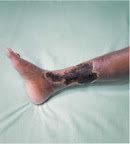 Betty was 95. She lived in a nursing home. She was delirious and bedbound. She had diabetes, emphysema, untreatable ischaemic heart disease, and a recent stroke. And now she had a fever and a gangrenous leg.
She was going to die, sooner or later.
"She's a fighter" her son said. "Before she became delirious, she told me that she'd rather lose her leg than die."
I didn't say what I was thinking - "This is not a life. You are just torturing her. She is going to die anyway."
Instead I say: "I appreciate what you are saying, but you must understand that amputating her leg has a very high chance of killing her, both immediately and in the near future. And even if she were to survive that operation her quality of life would only be worse, not better. She would definitely never walk again."
"We know that, doc, but we'd rather she die under an anaesthetic than like this. We know that's what she'd want. She doesn't walk as it is."
Perhaps I am weak, but I cannot flat out refuse to do it. I don't know for certain that she will die. She might pull through. Her chances are poor, but they are not zero.
Two days later she is awake and talking to her family. She thanks me for doing the amputation, and goes back to her nursing home. A week later I hear that she has had a "heart attack" and has passed away.
-----
Jerry is 70. He came from a hostel. He was confused but relatively independent , until he developed acute appendicitis. A diagnosis made at laparotomy. He makes a good recovery, but unfortunately, a pressure sore develops on his heel. Bone is exposed, and needs debridement. Malnutrition limits what healing is present. The arterial supply is limited. He is too confused to eat. He needs nasogastric feeding, an angiogram and a small operation to clean his ulcer."We don't think he would appreciate it, doc." said the daughter. "He doesn't know what is going on. He won't want to risk losing his leg. We're sure he wouldn't want a tube in his nose. Why can't we let him die with dignity?"
"He is not going to die anytime soon." I say. "But this ulcer will be with him for the rest of his days unless we remove the bone and put a skin graft on it. The ulcer won't kill him but it will cause him pain."
"We think he's had enough. We'd like to speak to the palliative care nurse."
Palliative care takes him over and he is dosed up to his eyeballs with subcut morphine. A month later he is still alive. I wonder how long he will last at the hospice, and how much morphine he can handle.
-----
 John was 65, living with cerebral palsy, schizophrenia, and a recently fractured humerus. Paraplegic and confused. He had recently been transferred into a nursing home where he was fully dependent. Now he had severe, sudden onset abdominal pain. There was gas under his diaphragm. There was no doubt he had a perforated viscus. Probably a duodenal ulcer. Laparotomy would be straightforward and life-saving. "I'm not going to die, doc. Just give me some pain killers and let me go home. I don't want an operation." he said.
There was no family. They had abandoned him years ago. His sister hung up the phone when rung at 2am in the morning. The GP that normally treated John was on holiday. From the little information I could gather, his quality of life was non-existent. Who do I ask? Who do I turn to? Do I have the right to decide whether to operate or palliate? In his incapacitated state does he have the right to refuse surgery?
So I passed the buck, and called the Chief Medical Officer. "What do I do?" I ask. "You are authorised under law to do as you see fit. As the clinician on duty, the hospital will support your decision." came the drab reply over the telephone.
So I wrote up the omeprazole, turned up the morphine infusion, and went back to sleep.
Tuesday, June 06, 2006
Happy Happy Joy Joy
Yesterday I received some very good news. A significant amount of time was spent celebrating, and a significant amount of time this morning was spent recovering. Luckily, the hangover had subsided by the time the emergency redo laparotomy rolled in the door at 1300h. Obviously bad news does not care when good news arrives.

Subscribe to:
Posts (Atom)



 Posts
Posts


